What Causes the Seasons? Earth's Tilt, Not Its Distance
The seasons are caused by the tilt of Earth's axis. The axis stays pointed in roughly the same direction in space while Earth orbits the Sun, so for part of the year the Northern Hemisphere leans toward the Sun and for the rest of the year it leans away. The side that leans toward the Sun gets more direct sunlight and longer days, which is summer there. Earth's distance from the Sun plays almost no part.
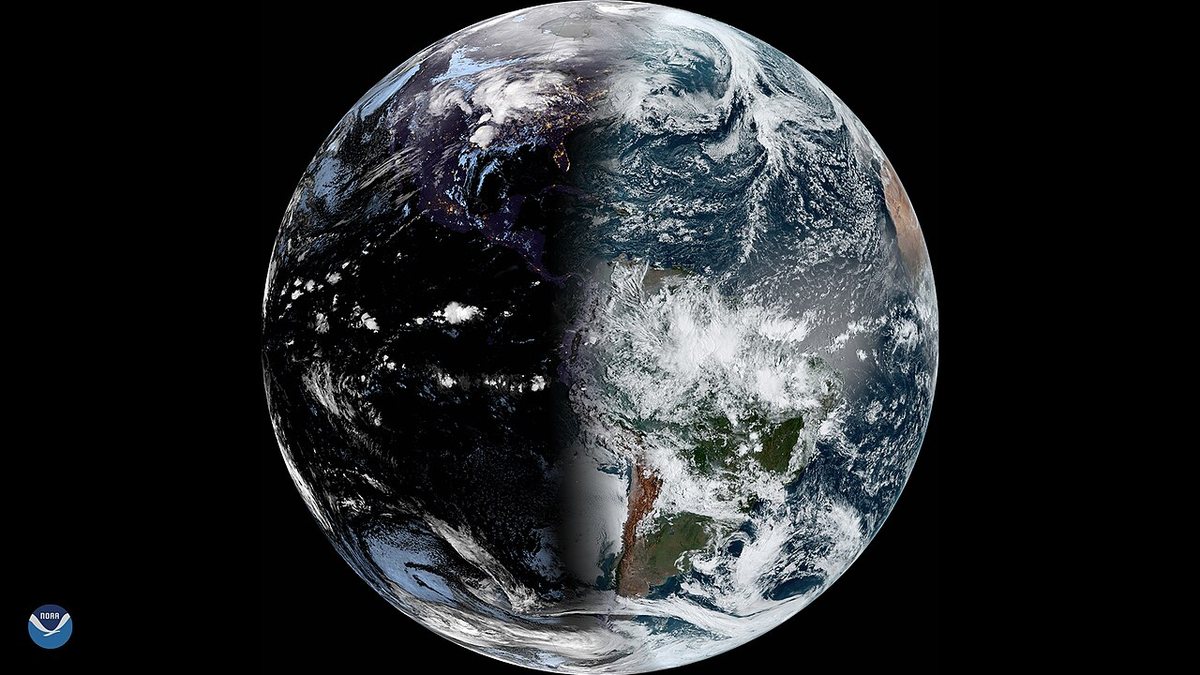
Key takeaways
- Earth's axis is tilted about 23.4 degrees. NASA's Earth fact sheet lists the obliquity as 23.44 degrees.
- The axis keeps roughly the same direction as Earth travels around the Sun, so each hemisphere takes its turn leaning toward the Sun.
- Tilt changes two things: the angle of sunlight and the length of the day.
- Earth is closest to the Sun in early January, when the Northern Hemisphere has winter. Distance cannot be the main cause.
The short answer: a tilted axis
Earth spins on an axis that runs from the North Pole to the South Pole. That axis is not upright relative to the plane of Earth's orbit. It leans by about 23.4 degrees. As Earth travels once around the Sun in a year, the axis keeps pointing in roughly the same direction in space. The Northern Hemisphere therefore faces the Sun for part of the year and faces away for the rest, and the Southern Hemisphere does the opposite.
NASA's Space Place summarizes the mechanism in one line: Earth's tilted axis causes the seasons. When the North Pole points toward the Sun, the northern half of the planet gets more sunlight and summer arrives. When it points away, there is less sunlight and winter arrives.
How tilt changes sunlight
Tilt affects the seasons through two linked effects. The first is the angle of the Sun's rays. When the Sun is high in the sky, its rays arrive close to straight down, so a fixed amount of energy lands on a small patch of ground. When the Sun is low, the same rays arrive at a slant and spread across a wider area. Low-angle light also passes through more air before it reaches the surface, which weakens it further.
The second effect is day length. In the hemisphere tilted toward the Sun, the Sun traces a longer path across the sky, so the day has more hours of light and the ground has less time to cool overnight. A higher Sun and longer days together bring warmer weather. The reverse happens in the hemisphere tilted away.
Why distance is not the cause
Many people assume summer happens when Earth is nearest the Sun. In the Northern Hemisphere, the opposite is true. Earth's orbit is slightly oval rather than a perfect circle. NASA's Earth fact sheet gives its orbital eccentricity as 0.0167, which is small. Earth reaches perihelion, its closest point to the Sun, in early January, at about 147.1 million kilometers. It reaches aphelion, its farthest point, in early July, at about 152.1 million kilometers.
That gap is about 5 million kilometers, roughly 3 percent of the average distance. NASA's Space Place notes that the Northern Hemisphere has winter when Earth is closest and summer when it is farthest, and that this change in distance does not make much difference to our weather. The shape of the orbit is described by Kepler's laws of planetary motion, which say planets move in ellipses with the Sun at one focus. The orbit's shape is a small effect next to the tilt.
Solstices and equinoxes
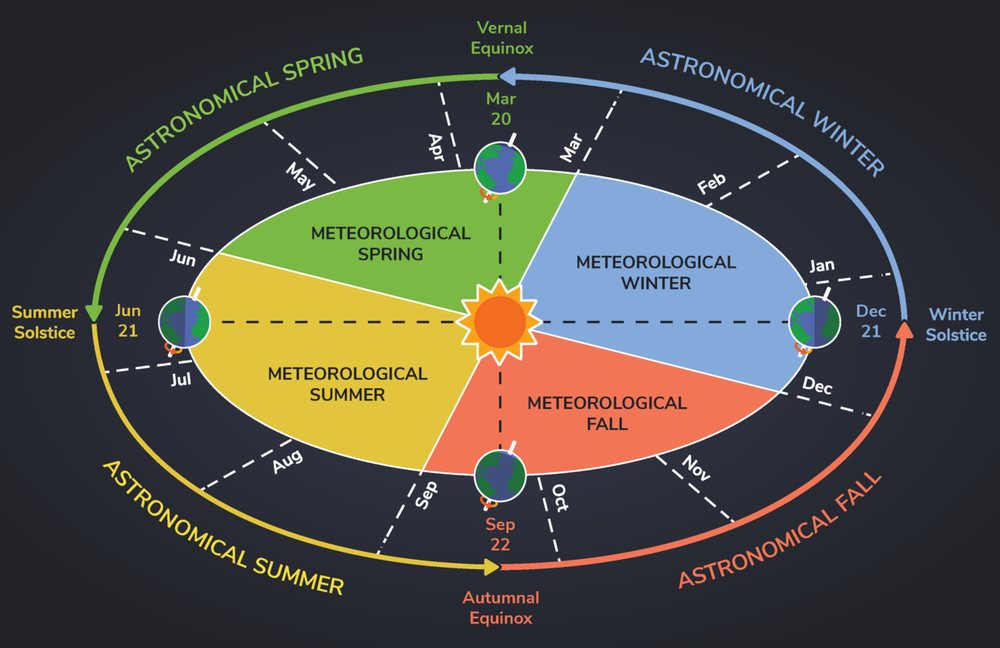
Astronomers mark the seasons with four points on Earth's orbit. The June solstice, around June 21, is when the Northern Hemisphere is tilted most toward the Sun, giving its longest day. The December solstice, around December 21, is when it is tilted most away, giving its shortest day. The two equinoxes fall between them, around March 20 and September 22. On those dates the Sun crosses the equator, and day and night are close to equal in length.
The dates are approximate. A calendar year is not exactly the length of Earth's orbit, so the exact day shifts from one year to the next.
How high the noon Sun climbs
The tilt is easy to see in the Sun's highest point each day. At solar noon, the Sun's altitude above the horizon equals 90 degrees minus the difference between your latitude and the latitude where the Sun is directly overhead. At the solstices, that overhead point sits about 23.44 degrees north or south of the equator. The table applies that formula. The numbers are calculated from the tilt, not measured at each site.
| Location | Latitude | June solstice | December solstice |
|---|---|---|---|
| Equator | 0° | 66.6° | 66.6° |
| Mid-latitude | 40° N | 73.4° | 26.6° |
| Arctic Circle | 66.56° N | 46.9° | 0.0° |
A location at 40° N, roughly the latitude of Madrid or New York City, sees the noon Sun about 47 degrees higher in June than in December. At the Arctic Circle, the noon Sun just touches the horizon on the December solstice. A higher Sun concentrates sunlight on less ground, which is why the seasons are strongest away from the equator.
Opposite seasons in two hemispheres
Because the axis keeps its direction, the hemispheres always lean in opposite ways. When June brings summer to the north, it brings winter to the south. NASA notes that the poles experience opposite timing, so the Southern Hemisphere's summer falls around December, when the north is in winter.
Near the equator, the Sun stays high in the sky all year, so temperature differences between seasons are usually small. Many tropical places instead have wet and dry seasons that follow shifts in rainfall. The jet stream also moves north and south through the year, which is one reason storm tracks in the middle latitudes change with the season.
Why the seasons reach the whole planet
The sunlight that changes with the seasons does not stay where it lands. Oceans absorb and store heat, and ocean currents carry that heat around the planet, which softens the winters of some coastal regions and the summers of others. The greenhouse effect controls how much of the absorbed heat the lower atmosphere holds onto. Plants respond too: the light that drives photosynthesis is strongest when the Sun is high and the days are long, which is why growing seasons largely follow the same timing.
Frequently asked questions
Is Earth closer to the Sun in summer?
No. Earth is closest to the Sun in early January and farthest in early July. The Northern Hemisphere has summer in June because it is tilted toward the Sun, even though the planet is farther away.
Do the seasons happen at the same time everywhere?
No. The two hemispheres have opposite seasons, so June is summer in the north and winter in the south. Within a hemisphere, places farther from the equator see larger differences between seasons.
What is the difference between a solstice and an equinox?
A solstice is the day the Sun reaches its farthest point north or south of the equator, which gives the longest or shortest day in each hemisphere. An equinox is when the Sun crosses the equator, and day and night are close to equal in length.
Why are the season dates not the same every year?
A calendar year does not match the length of Earth's orbit exactly, so the solstice and equinox dates move by a day or so from year to year. The dates on this page are approximate.
Would Earth have seasons without its tilt?
Earth would still have small variations from its slightly oval orbit, but the large seasonal swings in sunlight would largely disappear. Without tilt, the Sun's noon height at each latitude would stay about the same all year.
Sources and image credits
- NASA Space Place, What Causes the Seasons? (tilt, the January perihelion and July aphelion, opposite hemispheres)
- NASA Goddard, Earth Fact Sheet (obliquity 23.44 degrees, orbital eccentricity 0.0167, perihelion 147.095 and aphelion 152.100 million km)
- NOAA Office of Education, Meteorological and Astronomical Seasons infographic (solstice and equinox dates)
The noon-altitude table is calculated from the 23.44-degree tilt using the standard relation between latitude and the Sun's declination. Photo credits appear under each image.
Related reading
- Why Leaves Change Color in Autumn, a companion explainer on the other visible sign of the season.
- Kepler's Laws of Planetary Motion
- The Greenhouse Effect