How to Remain Valuable When Intelligence Becomes Cheap
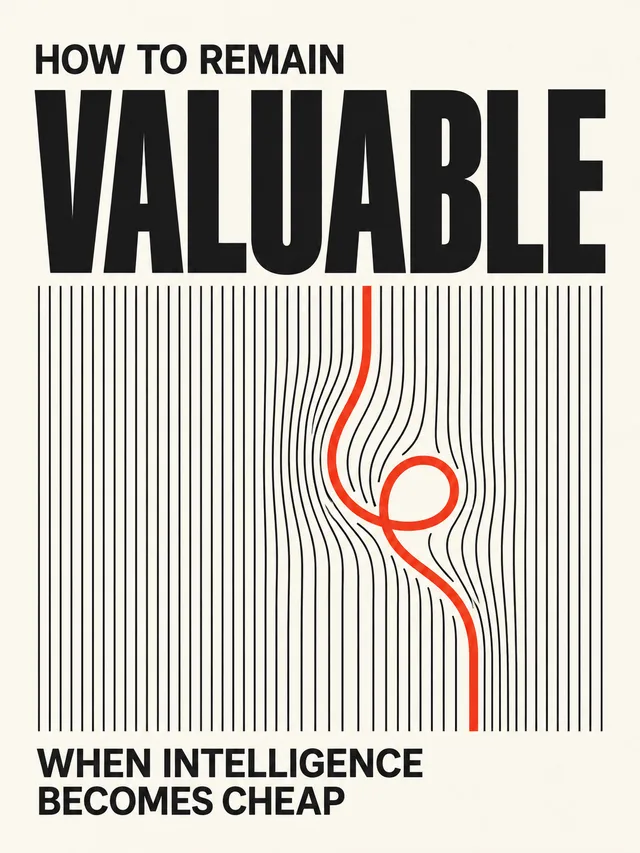
A 224-page practical book about the scarce human, economic, and strategic advantages that stay valuable even when AI can do most cognitive work.
The argument
When thinking becomes cheap, the price of thinking falls — and the price of everything thinking cannot supply rises. The book is a map of that second list: judgment, taste, trust, reputation, ownership, access, relationships, physical resources, distribution, accountability, attention, and time. It is not a tools tutorial; “learn to use AI” is treated as a depreciating skill, and the book says why.
It then turns the map into practice: how to direct agents instead of competing with them, where to build, what to own, how to keep learning with AI, and a five-year planning framework that considers gradual and abrupt progress.
What is inside
Nine parts and a conclusion:
Part I · The End of Expensive Intelligence
- Why intelligence used to command a price
- What happens when thinking becomes abundant
- Intelligence, capability, agency
- Why “learn to use AI” is not a durable strategy
Part II · What Actually Remains Scarce
- Judgment
- Taste
- Trust
- Reputation
- Ownership
- Access
- Relationships
- Physical resources
- Distribution
- Responsibility and accountability
- Attention
- Time
Part III · Agency: The Ability to Make Things Happen
- Goals versus prompts
- Turning ambiguity into action
- Delegating to machines
- Verifying autonomous systems
- Building feedback loops
- Operating fleets of agents
- Knowing when not to automate
Part IV · Building in an AGI Economy
- From worker to orchestrator
- Tiny teams with enormous output
- Software after software becomes cheap
- Products built by agents
- Personal infrastructure and automation
- Distribution as the bottleneck
- Why businesses still exist when execution is automated
Part V · Money, Ownership, and Economic Power
- Labor income when labor becomes abundant
- Capital, equity, intellectual property, and infrastructure
- Owning systems instead of merely operating them
- Commoditization and margins
- AI-driven entrepreneurship
- Winner-take-most dynamics
- Personal financial resilience under rapid technological change
Part VI · Learning After AI Can Know Everything
- Why knowledge still matters
- Learning for mental models rather than memorization
- Five foundational lenses
- Asking better questions
- Detecting hallucinations and false confidence
- Developing independent judgment
- Learning faster with machine tutors
Part VII · Human Advantage
- Taste and aesthetic judgment
- Social intelligence
- Negotiation
- Leadership
- Curiosity
- Originality
- Courage under uncertainty
- Identity and meaning when occupation stops defining people
Part VIII · Power, Institutions, and Society
- Governments and AGI
- Corporations and concentrated compute
- Open versus closed intelligence
- Surveillance and privacy
- Education
- Employment
- Universal basic income and alternative distribution systems
- Geopolitical consequences
- Why institutional adaptation may lag technological capability
Part IX · Personal Strategy for the Next Five Years
- What to build
- What to learn
- What to own
- What to automate
- What not to outsource
- Creating multiple sources of leverage
- Designing an AI-native career
- Preparing for both gradual and extremely rapid progress
Conclusion · Intelligence Is Cheap; Consequences Are Not
Who it is for
Knowledge workers, builders, founders, students, and anyone whose income today depends on producing text, code, analysis, or design — and who would rather plan for the shift than be surprised by it.
Read the ideas for free first
gor.bio stays free. The articles closest to the book’s themes: Large language models, Supply and demand, Opportunity cost, The Industrial Revolution, The printing press, and Game theory.