Why Leaves Change Color in Autumn
Leaves change color in autumn because chlorophyll, the green pigment, breaks down and is no longer replaced. That reveals yellow and orange pigments that were in the leaf all summer. Red and purple come from a different pigment, anthocyanin, which some trees make in the fall from sugars trapped in their leaves. Lengthening nights set the timing, while weather mostly shapes how vivid the display is.
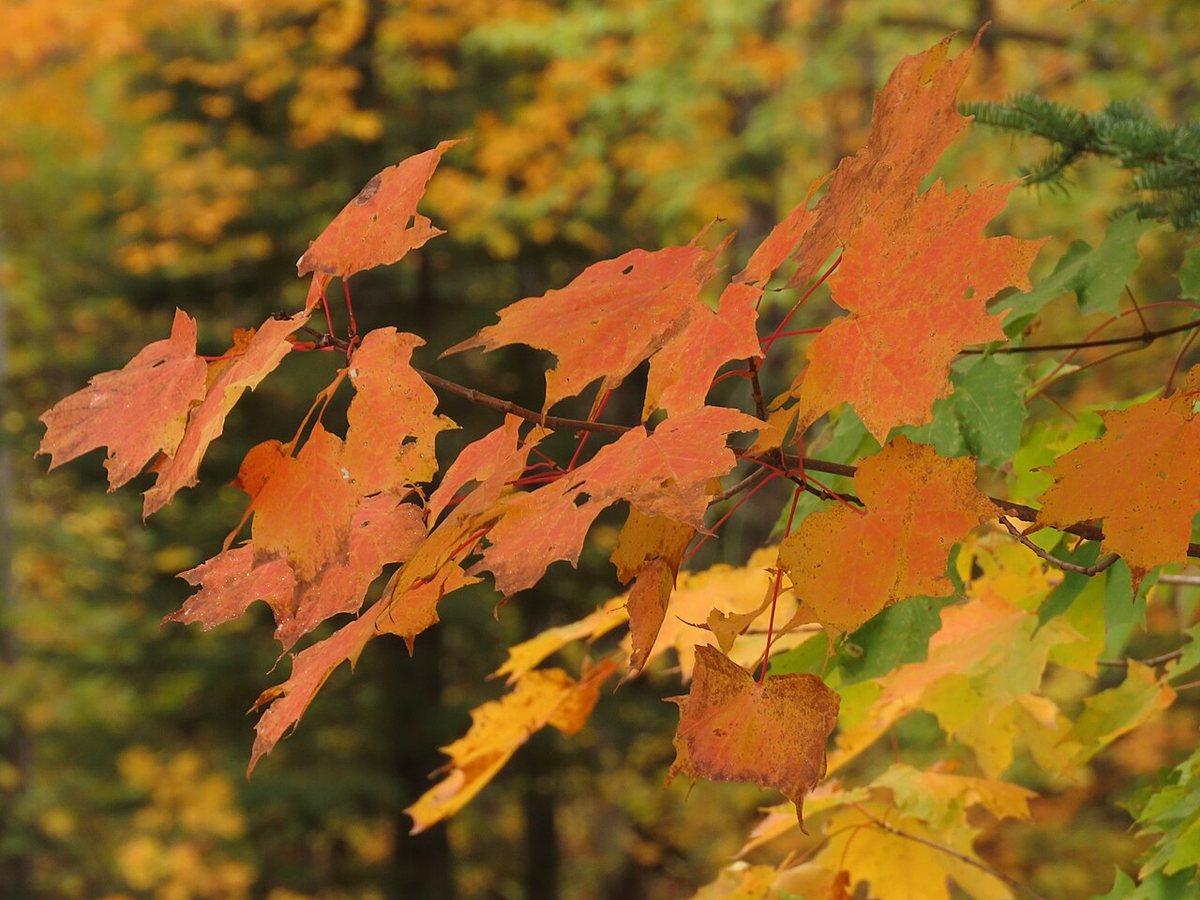
Key takeaways
- Chlorophyll is rebuilt all summer. In autumn, production slows and stops, and the green fades.
- Yellow and orange carotenoids are in the leaf all season, hidden by the green.
- Red and purple come mostly from anthocyanins that some trees make in autumn from sugars trapped in the leaf.
- Lengthening nights trigger a corky layer at the base of each leaf stalk. That layer cuts off the flow of materials, and the leaf eventually falls.
Green is the top layer
Chlorophyll is the pigment inside chloroplasts that captures light for photosynthesis. It absorbs red and blue light most strongly and reflects green, which is why leaves look green to us. Those colors are wavelengths of visible light, a small slice of the electromagnetic spectrum.
The pigment is not permanent. The USDA's science summary of autumn color says that during the growing season chlorophyll is replaced constantly, and that it breaks down in light much as colored paper fades in sunlight. A leaf that keeps making new chlorophyll stays green. A leaf that stops making it loses its green.
Yellow and orange were there all along
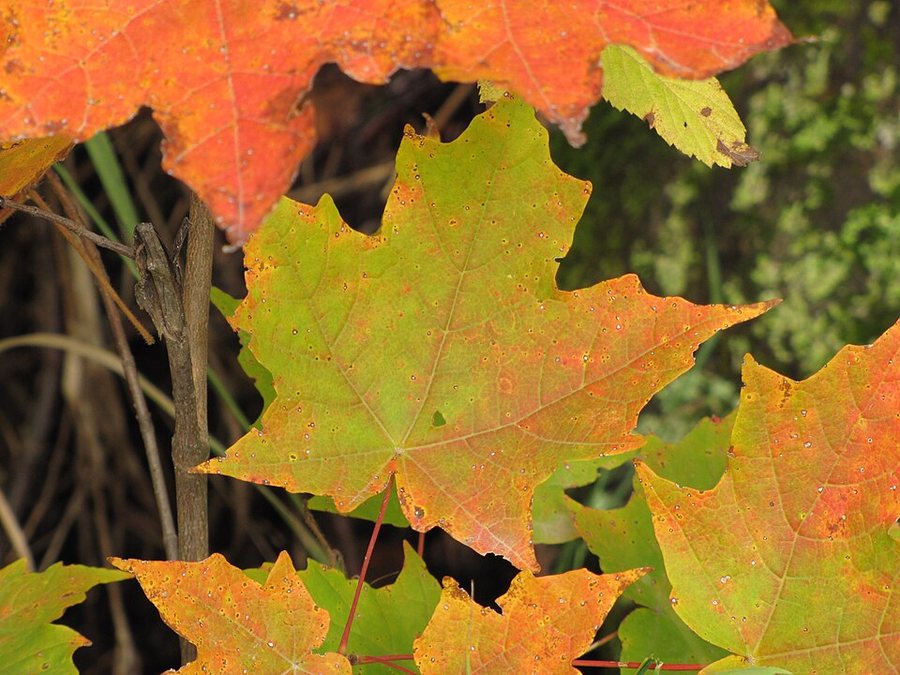
Yellow pigments called xanthophylls and orange pigments called carotenoids are present in the leaf throughout the growing season. Green chlorophyll is so abundant that it masks them. When the chlorophyll is gone, they show. That is why a single tree can display green, gold and orange at the same time: each leaf is at a different point in the fading.
Why some trees turn red
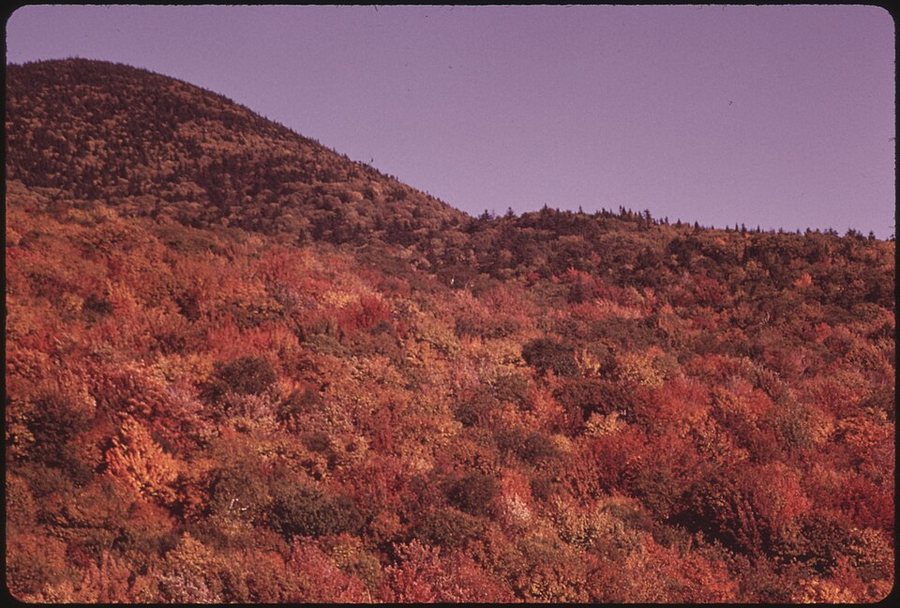
Red and purple colors come mainly from anthocyanins. In most plants these pigments are not present during the growing season. In autumn, according to the USDA summary, anthocyanins are manufactured from the sugars trapped in the leaf. Not every species makes them, so a hillside often shows a mix of red, gold and brown.
The 1973 hillside photograph below shows that mix. Its archival title lists red and sugar maples, beech and yellow birch on the lower slopes.
Why the display differs from place to place
The character of autumn color changes with the forest. The USDA summary contrasts a few regions. In New England and northeastern Asia, a few species dominate the forest, so the display is short but intense because the change is rapid and fairly uniform. In the southern Appalachians the change is often more gradual, and the season can last more than a month because many plant species grow together.
Mixed forests with both evergreen conifers, such as spruce, and deciduous trees, such as aspen or larch, are found in the far north and at high elevations. There the dominant color is yellow, and trees often go from green through bright yellow to bare over about two weeks. In tropical forests, many deciduous trees drop their leaves in response to drought, and the leaves typically fall before they change color.
Weather changes the intensity, not the timing
Many people think frost causes leaves to change color. The USDA summary corrects that: temperature may dictate the color and its intensity, but it is only one of many environmental factors, and the process itself starts with night length. The best displays come from a combination of conditions. The summary describes them as a growing season with plenty of moisture, followed by a dry, cool, sunny autumn with warm days and cool but frost-free nights. Cool nights together with abundant sunshine favor the formation of more anthocyanins. Sunshine also works against the green: abundant light and low temperatures after the abscission layer forms speed up the destruction of chlorophyll.
Two weather effects can shorten a display. Freezing conditions destroy the machinery that makes anthocyanins, so an early frost ends the color early. Drought during the growing season can sometimes trigger early leaf drop, and wind or heavy rain can strip leaves before they color fully.
Timing and intensity are different things. Because night length sets the start, colors appear at about the same time each year in a given place, whether temperatures run warmer or cooler than normal.
The leaf is sealed off
Shorter days and longer nights start the process. When nights pass a threshold length, cells where the leaf meets the stem divide rapidly without growing. Those cells form the abscission layer, a corky layer that slowly blocks the transport of sugars from the leaf to the branch and the flow of minerals from the roots into the leaf.
Once that connection is cut, chlorophyll production slows and then stops, and the other pigments become visible. Breaking down pigments and proteins inside the leaf is an enzyme-driven process, the same kind of catalysis described in enzymes. Leaf aging is also regulated: it involves switching sets of genes on and off, as covered in gene expression.
As the layer dries and weakens, the leaf eventually breaks off. The USDA notes that many trees and shrubs lose their leaves while they are still very colorful, and that the colors do not last long. The pigments eventually break down too. The only one that remains is tannin, which is brown.
Frequently asked questions
Does frost make leaves change color?
Not directly. Night length starts the process, so frost does not set the timing. Temperature can affect how intense the colors are, and an early freeze can end a display early because it destroys the machinery that makes red pigments.
Why are some leaves yellow and others red?
Yellow and orange come from carotenoids and xanthophylls that were in the leaf all season. Red and purple come mostly from anthocyanins that some species make in autumn. A tree that makes few anthocyanins mainly shows yellow and orange, and once those pigments break down, the brown of tannins is what remains.
Why do leaves fall off trees in autumn?
Each leaf stalk forms an abscission layer. The corky layer blocks the flow of sugars out of the leaf and minerals into it, then weakens over time until the leaf breaks off.
Does a tree keep making food in autumn?
Less and less. As the connection to the leaf is blocked, chlorophyll production slows and stops, so photosynthesis winds down. During the growing season, trees store carbohydrates in their branches, roots and buds to support next year's growth, as the USDA summary describes.
Why do the colors look different from year to year?
Weather in late summer and autumn changes the display. A dry, cool, sunny autumn with warm days and cool but frost-free nights tends to give the brightest colors. Early frost, wind or heavy rain can shorten the show.
Sources and image credits
- USDA, The Science of Color in Autumn Leaves (archived 2018 copy; the live USDA page was not reachable when this article was checked)
- Photo credits: each image caption links to its Wikimedia Commons file page, which lists the photographer, the date and the public-domain status.
Related reading
- What Causes the Seasons?, a companion explainer on why the season changes in the first place.
- Photosynthesis
- Gene Expression